

Challenges Facing Neighborhood Councils in Los Angeles Today: The true identity of any city is not defined by its streets, bridges, or skyscrapers, but by the people who live, work, and dream there, and who shape its direction through their daily decisions. “Participatory urban governance” is based on this idea—that city administration should not be solely the domain of elected representatives or bureaucrats, but that ordinary citizens should also be formally involved in policymaking and decision-making processes. For several decades, this topic has been a subject of intense interest for planners, sociologists, and public administration scholars, as it represents an attempt to revitalize democracy at the local level.
In the early 1990s, several cities in the United States began adopting institutional models that allowed residents to form boards or councils, hold elections, and provide official input on city-level legislation. Over time, these experiments evolved into “neighborhood councils.” While their structure may vary across different countries, the core idea remains the same—that policies should be grounded in people’s experiences.
Neighborhood-Level Governance: The Closest Face of Democracy

Neighborhoods have long been considered the fundamental unit of civic organization and community participation. As cities faced economic decline, social fragmentation, and administrative distance, local governance structures emerged as a solution. Their aim was to ensure that policies were grounded in reality and to restore public trust in government. Early studies found that such models could improve service delivery, empower citizens with greater information and confidence, and enhance social capital—that is, mutual trust and cooperation.
However, not every city’s model is the same. Some began as informal groups, while others developed into robust institutions with clearly defined boundaries, bylaws, elections, and annual allocations of public funds. This diversity has also led to disagreements among scholars—do these initiatives truly deepen democracy, or do they merely replicate existing inequalities in new forms?
Global Perspective: The Growing Trend of Decentralization
Participatory governance has not been limited to the United States. In the United Kingdom, the formal system of “Neighborhood Planning” has attempted to give local development a voice, while in China, the weakening of the state-controlled housing system and the emergence of private management companies and homeowner associations have created new local governance structures. These examples illustrate that the form of neighborhood governance depends on local socio-economic conditions, the role of the state, and the strength of civil society organizations.
A crucial question arises everywhere—are these structures truly democratic? Do they give as much voice to economically disadvantaged groups as they do to affluent communities?
Los Angeles: One City, Many Inequalities, and 99 Neighborhood Councils
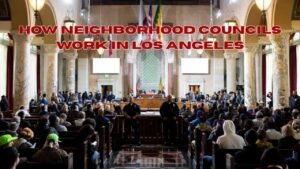
Los Angeles (LA) is an ideal case study for this topic. It has the country’s largest and most organized neighborhood council system, administered by the Department of Neighborhood Empowerment (DONE). Nearly the entire city is divided into 99 councils, each receiving public funding annually. Elections are held, and board members can represent diverse communities—such as small businesses, non-profits, and even the homeless.
This model is inclusive in many ways—US citizenship is not required to vote, and the minimum voting age is 16. Yet LA is a city with extreme income and wealth inequality. Research suggests that council board members are, on average, wealthier and whiter than their communities. This raises the question of whether these institutions provide equal opportunities or simply empower already privileged individuals.
Empowerment or Entrenchment? The Heart of the Debate

Some scholars argue that even if policy impact is limited, formal citizen participation in administrative structures is a democratic achievement in itself. Critics, on the other hand, contend that “high-functioning” councils appear successful because they are located in already affluent areas where residents have more time, networks, and political capital. This makes achieving similar levels of participation difficult for working-class or economically disadvantaged communities.
Furthermore, the demand for local control can sometimes foster “NIMBYism” (Not In My Backyard)—where residents oppose high-density or affordable housing projects in their neighborhoods, making it harder to address city-wide housing crises. This complicates the normative ideal of participatory governance—more participation doesn’t necessarily lead to better outcomes.
A New Perspective: Councils as Policy Actors, Not Just Participants
Recent studies add a new layer to this debate. Researchers compared the policy advocacy of councils in neighborhoods with varying socioeconomic backgrounds. They analyzed official documents such as “Community Impact Statements,” through which councils register their positions on city-level issues, and also conducted interviews with DONE staff.
The results were surprising. While it was expected that councils in affluent areas would be more active, the study revealed some common trends:
- Policy Parity – Councils from different neighborhoods sought decision-making power at the local level.
- Emerging Progressive Thinking – Many board members demonstrated progressive stances on issues such as social justice, housing rights, and community services.
- Collaboration Among Councils – Councils do not operate in isolation; they form alliances to raise a collective voice on broader issues.
This indicates that these bodies are no longer merely participatory platforms but are becoming centers of political entrepreneurship and coalition-building.
Research Methodology: Data, Documents, and Dialogue
To arrive at these conclusions, researchers used both qualitative and quantitative methods. Interviews with DONE staff helped identify which councils were active and institutionally capable. Records of official statements over several years were then studied to see which issues the councils addressed and how frequently. Comparative analysis was conducted by selecting councils from areas with different income levels using socio-economic maps.
Implications for the Future: A New Meaning of Participation
A crucial point emerges from these findings—neighborhood governance cannot be limited to being merely a democratic experiment. These institutions can become active players in policymaking, provided they receive resources, training, and an inclusive framework. Furthermore, equitable participation is not possible through administrative reforms alone, without addressing broader economic inequalities.
Future research and policies must understand how collaboration among local organizations develops, how they form alliances on city-level issues, and how to ensure that marginalized communities are equally included in this process.
Conclusion: City Democracy Begins in the Neighborhood
Neighborhood councils remind us that democracy is not just an electoral process, but a continuous practice of dialogue, participation, and collective responsibility. These models represent both possibilities and limitations. They can be instruments of empowerment, but also reflections of existing inequalities. The real challenge lies in developing these initiatives in a way that allows every citizen, regardless of their economic status, to have a voice in shaping the city’s future.
Ultimately, it is when people become stakeholders in the decisions that affect their surroundings that a city transforms from merely a place to live into a place of shared ownership and hope.
